
Plenary Details
Plenary session 1 - Day 1
Title
From static reviews to a learning and living ecosystem.
Date and Time
8th December 2026 at 9:00.
Co-Chairs
Amir Qaseem (American College of Physicians, USA)
Firmaye Bogale(Center for Evidence-synthesis, Support & Development in Africa (CESDA), Ethiopia)
Description
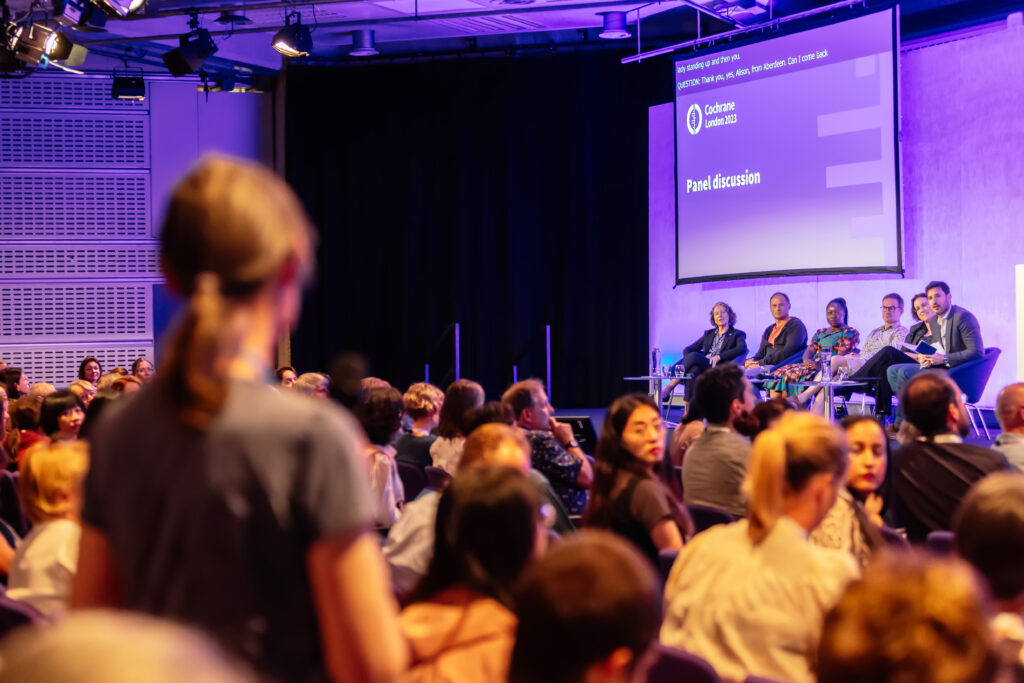
Opening keynote speech will focus on the failure of the current system of classical review and how the future system of living and learning ecosystem could improve both evidence synthesis and primary research. It will be followed by a panel discussion in which panelists respond to the keynote presentation from their respective perspectives focusing on practical examples and solutions.
Opening keynote speech
Philippe Ravaud (Centre for Research in Epidemiology and Statistics (CRESS), Paris Cité University Sorbonne Paris North University, National Institute of Health and Medical Research (Inserm), French National Research Institute for Agriculture, Food and Environment (INRAe); France)
Responders’ perspectives
- Methods perspective (Laurenz Mahlanza-Langer; Pan-African Collective for Evidence NPC (PACE); South Africa)
- Evidence intermediary perspective (Rhona Mijumbi; the Africa Centre for Systematic Reviews and Knowledge Translation, Makerere University College of Health Sciences oin Kampala, Uganda)
- Policy-maker perspective (Tamille Sales Dias; National School of Public Administration (ENAP), Brazil)
- Real word evidence perspective (Rafael Vieira; the Faculty of Medicine of the University of Porto, Portugal)
- Funders perspective (Isabel Fletcher; Wellcome Trust, United Kingdom)
Plenary session 2 - Day 2
Title
Should AI change the way we think about evidence synthesis?
Date and Time
9th December 2026 at 9:00.
Co-Chairs
Ivan D. Florez (University of Antioquia, Colombia, McMaster University, Canada)
Nadia Soliman (Evidence for Policy and Practice Information Centre (EPPI Centre), United Kingdom)
Description
AI is changing how people /consumers interact with information and access evidence, with many users relying on AI-generated answers through AI agents rather than consulting original sources. This raises important questions about trust, transparency, and the future role of organizations such as Cochrane. The objective of the session is to explore how artificial intelligence is transforming the production, interpretation, and use of evidence, and to critically assess its implications for: scientific rigor, trust and accountability, decision-making and the future role of evidence synthesis (including Cochrane). The plenary aims to move beyond technical discussions and instead challenge the field to rethink the role, purpose, and future of evidence synthesis in the age of AI, balancing efficiency, trust, and relevance.
The panel includes experts from diverse backgrounds:
- Evidence synthesis and systematic reviews (Ashrita Saran; Global Development Network, India)
- Policy and decision-making (Harsha Dayal; The South African Presidency, South Africa)
- Climate science and large-scale assessments (Jan Minx; Potsdam Institute for Climate Impact Research (PIK), Germany)
- Editorial and publishing perspectives (Rupa Sarkar; Cochrane Collaboration)
Plenary session 3 - Day 3
Title
Building Fairer Evidence Ecosystems Together.
Date and Time
10th December 2026 at 9:00.
Co-Chairs
Jordi Pardo Pardo, University of Ottawa, Canada
Yemisi Takwoingi, University of Birmingham, United Kingdom
Description
Evidence synthesis and guideline development increasingly recognize the importance of equity, inclusion, co-production, and partnerships. However, many challenges remain in ensuring that evidence ecosystems are truly representative, participatory, and responsive to the needs of diverse communities.
This plenary will move beyond theoretical discussions to focus on practical solutions and real-world experiences. Through short reflections from panelists and an interactive discussion, the session will explore how evidence organizations can foster meaningful participation, address power imbalances, strengthen partnerships, and create more equitable evidence production and use.
The panel includes speakers from diverse backgrounds:
- Juan Franco (Evidence Synthesis Unit Lead / Cochrane Governing Board Member, Heinrich-Heine-University-Düsseldorf) Germany
- Joanne Khabsa (AUB GRADE Center Coordinator, American University Of Beirut, Lebanon)
- Nasreen Jessani (Stellenbosch University, South Africa)
- Euphrasia Ebai-Atuh Ndi (Ministry Of Secondary Education, Cameroon/ Cameroon Consumer Service Organisation (CamCoSO)
Cochrane Lecture (Day 3)
Title
The fight for facts: Evidence in an age of doubt
Date and Time
10 December 2026 at 16:00.
Chairs
TBA
Description
How did evidence come to shape decision-making in medicine, policy and beyond — and why is evidence now under attack? In this lecture, science journalist and author Helen Pearson will explore the rise of evidence-based thinking and the forces that work to distort, undermine and dismiss knowledge from research. How can today’s champions of evidence navigate misinformation, AI and fracturing public trust in science?